Table Of Contents
Outdoor Catering in Scottsdale: How to Handle 100°F+ Heat the Right Way
Scottsdale Heat Is a Variable You Must Control — And Triple-Digit Temperatures Are the New Normal
Anyone who has hosted a backyard gathering in Scottsdale knows the feeling: you check the forecast, see 108°F, and think we'll manage.
But managing heat and controlling it are two very different things—especially when food, guests, and liability are involved.
Triple-digit temperatures can arrive as early as March, and by May, late afternoon outdoor events are operating in conditions most people underestimate.
In 2025, one of the hottest years on record in the Phoenix metro, this isn't an anomaly. It's the new baseline.
Every Element of Your Event Feels the Heat
Outdoor parties mean prolonged exposure to 100°F+ conditions—for your guests, your food, your staff, and your equipment.
Ice melts faster than expected. Chafing dishes overshoot. The dip that was perfect at 11:00 a.m. becomes a liability by 11:45.
Heat is not an inconvenience you work around. It is the primary risk variable you must build a system around—and everything in this guide exists to help you understand why.
The 1-Hour Rule Most Backyard Hosts Get Wrong
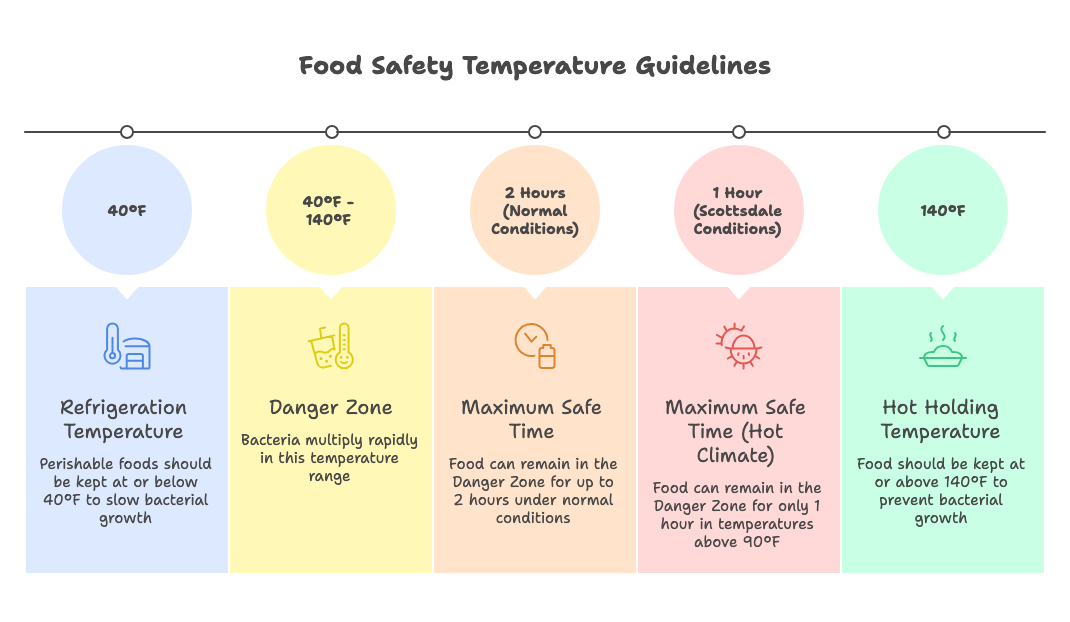
Understanding the FDA Danger Zone
Under normal conditions, perishable food shouldn't sit in that zone for more than two hours. Most hosts know this.
Far fewer know that when ambient temperatures exceed 90°F, that window drops to just one hour.
Why Scottsdale Compresses Every Food Safety Timeline
In Scottsdale, 90°F is a mild morning in June.
By the time guests arrive, find parking, pour drinks, and settle in, that one-hour clock is well underway—often before a plate has been touched.
At 100°F to 110°F, pathogens like Salmonella and Staph aureus multiply in real time, in the food sitting on your buffet table, under your shade structure, and in dishes set out during setup before a single guest arrived.
Knowing the rule is easy. Executing it consistently across an entire outdoor event is where most DIY efforts fall short.
Why Summer Parties Spike Foodborne Illness
The Numbers Every Host Should Know
Foodborne illness isn't reserved for questionable restaurant kitchens.
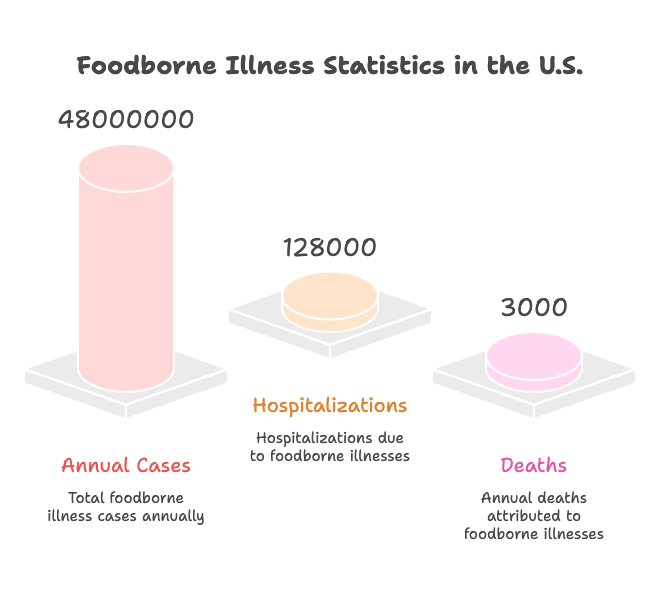
The CDC reports approximately 48 million cases annually—roughly one in six Americans.
Of those, 128,000 result in hospitalization and around 3,000 in death.
These numbers spike every summer, driven by outdoor dining conditions: higher ambient temperatures, longer food exposure windows, and limited access to temperature-controlled environments.
Arizona's Climate Elevates the Risk
A backyard party in Scottsdale in July doesn't just approach dangerous food temperatures—it can reach them before the first guest finishes their welcome drink.
Extended outdoor exposure in Phoenix-area heat compresses the timelines that standard food safety guidelines were built around.
This isn't a worst-case scenario. It's a statistically predictable outcome when proper controls aren't in place.
The Hidden Failure Points in DIY Outdoor Catering
The Most Common Mistakes Backyard Hosts Make
Most outdoor catering mishaps don't happen out of carelessness.
They happen because of specific, recurring failure points.
The most common: food sitting out during guest arrival delays.
Parties rarely start on time, and that 30-minute gap between "food is ready" and "guests are eating" is often when the danger zone clock runs out.
Equipment Errors and the "Set It and Forget It" Trap
Other frequent failures include cooler cross-contamination—mixing beverages and perishables in the same cooler—and the absence of active temperature monitoring.
Most DIY setups rely on visual cues rather than thermometers, which can't detect unsafe internal temperatures.
Without a clear rotation and discard protocol, the default becomes "set it and forget it"—a habit that's harmless indoors in winter and dangerous outdoors in August.
Transport is also a critical risk window.
Food loaded into a vehicle without insulated carriers can enter the danger zone before it reaches the table.
The Heat-Control System Professionals Use
Transport & Setup
A professional outdoor catering operation starts well before guests arrive.
Insulated carriers are loaded with strict hot/cold separation.
Equipment is pre-chilled or pre-heated before loading.
Shade is mapped in advance—where will the sun be at 1:00 p.m.? Which stations need repositioning as the afternoon progresses?
These are decisions made ahead of time, not improvised on-site.
Service Execution
Every dish is timestamped when it leaves the kitchen.
Rotation cycles run every 30 to 45 minutes, with dedicated staff tracking each station.
When a dish crosses its time or temperature threshold, it's discarded immediately and replaced.
That's not waste—it's the system functioning as designed.
Temperature Control Tools
Multiple calibrated thermometers are in use throughout service.
Ice baths and chilled platters maintain cold items independently of ambient coolers.
Chafing dishes and induction equipment keep hot foods above 140°F.
For larger Scottsdale events, backup refrigeration or generator-powered cooling provides redundancy when conditions push primary equipment to its limits.
This is a living system—not a one-time setup.
Why Certification Actually Matters in 105°F Heat
What Maricopa County Requires
Maricopa County requires food handlers at catered events to hold a valid, ANSI-accredited Food Handler Certificate.
At least one Certified Food Protection Manager (CFPM) must also be on-site.
These aren't administrative formalities—they represent verified competency in the exact conditions Scottsdale outdoor events create.
The Real Cost of Untrained Staff
Certified training covers temperature monitoring discipline, cross-contamination prevention, and rapid response protocols.
Contrast that with a well-intentioned team of friends or unvetted hired help.
In a climate-controlled kitchen, the margin for error is forgiving. In 105°F heat, with safety windows compressed and fatigue setting in, human error compounds fast.
Certification is evidence that your team is trained to make the right call precisely when conditions make the wrong one tempting.
Permits, Regulations & Compliance
What Scottsdale Events Actually Require
Catered outdoor events in Scottsdale can trigger several layers of compliance that catch hosts off guard.
Depending on the size and nature of your event, you may need a Scottsdale Special Event permit, a Maricopa County temporary food establishment permit, and Fire Department approval if grills or propane are involved.
Health inspection standards apply to catered events just as they do to licensed restaurants.
The Consequences of Getting It Wrong
Ignorance of these requirements offers no protection from their consequences—fines, event shutdowns, and liability exposure are all real outcomes.
A professional catering company operating regularly across Scottsdale and the Phoenix metro understands this regulatory landscape in detail and builds compliance into the event plan from the start.
Liability & Insurance: Who Pays If a Guest Gets Sick?
What Professional Caterers Carry
When a guest becomes ill after an event, the liability question arrives fast.
Professional caterers carry general liability insurance and product liability coverage that specifically addresses foodborne illness claims—covering medical costs, legal defense, and potential settlements.
The Risk the DIY Host Absorbs
In a DIY scenario, the homeowner absorbs 100% of that responsibility.
Pair that exposure with the CDC's data—one in six Americans affected annually—and the risk stops being hypothetical.
At a party of 60 guests, the math is uncomfortable.
Hiring a licensed, insured caterer doesn't just improve the food. It transfers a significant portion of the liability risk away from you.
Staff Endurance: The Overlooked Operational Risk
Heat Exhaustion Affects More Than Your Team's Comfort
Food safety conversations in extreme heat focus almost entirely on the food.
But the people managing that food face serious risks of their own—and their physical condition directly affects service quality and safety.
Heat exhaustion is a real occupational hazard for chefs and servers at outdoor Scottsdale events.
Professional operations address this with hydration protocols, scheduled breaks, cooling gear, and staff rotation systems to prevent sustained heat exposure.
Why Staff Performance Is a Food Safety Issue
Service breakdown is food safety breakdown.
A server experiencing heat fatigue is more likely to miss a rotation cycle, skip a temperature check, or let a dish sit longer than it should.
Maintaining consistency under physical stress isn't a soft concern—it's a hard operational requirement.
Professional catering companies build it into their staffing plans as a non-negotiable.
Summary: What Safe Outdoor Catering in Scottsdale Actually Requires
The Full Operational Stack
Safe, well-executed outdoor catering in Scottsdale requires all of the following working together:
- Active temperature control from the moment food is loaded for transport through the final course of service — not just at setup, but continuously throughout the event
- Timestamped dish rotation with immediate discard protocols that remove any item that has exceeded its safe window, regardless of how it looks or smells
- Certified, trained staff who maintain focus, accuracy, and food safety discipline even as physical conditions become increasingly demanding
- Full regulatory compliance with Scottsdale Special Event permits, Maricopa County temporary food establishment requirements, and Fire Department approvals where applicable
- Liability insurance — both general and product liability — that protects guests, hosts, and the catering team if an incident occurs
That's a significant operational stack—and it's precisely why "we'll just handle it ourselves" carries far more risk than most hosts anticipate. Each element depends on the others. Remove one, and the entire system becomes vulnerable.
Safe Events Are Engineered, Not Improvised
Outdoor catering in this climate isn't simply serving food outside.
It's managing a high-risk environment in real time, where heat amplifies every mistake and eliminates the margins that more forgiving conditions allow.
The hosts who pull off flawless outdoor events in Scottsdale aren't lucky—they're working with professionals who've built the systems to make it look effortless.
Ready to Plan Your Outdoor Event? Let's Talk.
At Tableside Gourmet, we specialize in luxury outdoor catering across Scottsdale and the greater Phoenix area—with the training, equipment, and heat-management systems to keep your event safe, seamless, and exceptional from the first course to the last.
Whether you're planning an intimate backyard birthday, a poolside brunch, an elegant wedding reception, or a large-scale corporate gathering, we bring a full-service approach built for Arizona's climate.
Contact Tableside Gourmet today to start planning an outdoor event that's as safe as it is unforgettable.
Frequently Asked Questions About Catering in Scottsdale’s Heat
1. What time of day is actually safest for an outdoor catered event in Scottsdale?
The safest times for outdoor events in Scottsdale are early mornings and after sunset, when temperatures are at their lowest. That said, evening events can still carry residual heat from the day, especially in summer when surfaces continue radiating warmth.
Late afternoon—typically between 3:00 p.m. and 6:00 p.m.—is often the most difficult window due to peak heat conditions. Timing helps reduce risk, but it doesn’t eliminate it. Even in “cooler” hours, proper temperature control systems are still essential.
2. Can shade structures or misters make outdoor food service safe on their own?
Shade and misters improve comfort, but they don’t make food service safe on their own. Shade reduces direct sunlight but doesn’t significantly lower air temperature, especially when it’s already above 100°F.
Misters can cool the surrounding area slightly, but they also introduce moisture, which can complicate food safety if not managed carefully. Neither solution keeps food out of the danger zone.
True safety comes from actively controlling food temperatures, not relying on environmental adjustments.
3. How do you safely serve food at a party that lasts several hours?
For longer events, food should be served in smaller batches rather than placed out all at once. This allows each dish to stay within its safe time window while being refreshed regularly.
Continuous monitoring and timely replacement are key to preventing food from sitting out too long. This approach not only reduces risk but also keeps food fresher and more appealing for guests throughout the event.
4. Are certain types of food better suited for extreme heat events?
Yes, some foods hold up better in extreme heat than others. Items that can be cooked and served immediately, like grilled dishes, tend to be more stable.
In contrast, foods that rely on strict cold holding—such as dairy-based or mayonnaise-heavy dishes—carry higher risk if not managed carefully.
A well-planned menu considers both flavor and practicality, choosing items that are easier to keep safe under high temperatures.
5. What’s the biggest misconception people have about outdoor catering in Arizona?
A common misconception is that food safety can be judged by how food looks or smells. In reality, harmful bacteria can grow without any visible signs.
Another is assuming that short exposure times are harmless, when Scottsdale heat significantly shortens safe windows. The real issue is relying on intuition instead of measurable controls.
In this climate, food safety comes down to strict time and temperature management—not guesswork.