Table Of Contents
How to Host an Indoor Luxury Dinner Party During Scottsdale's Summer Heat
Every host in the Valley knows the feeling. It's the second week of July, the thermometer reads 108°F at six in the evening, and you'd love to have people over. But the patio is out of the question, and the thought of standing over a hot stove while your guests wait in the other room makes postponing until October feel like the only sensible choice.
Don't postpone. Summer is one of the best times of year to host in Scottsdale. It simply requires a different approach than the one that works so well in November.
The Real Problem Isn't the Heat
Most summer entertaining advice treats temperature as the enemy. Indoors, that challenge is largely solved. Your air conditioning works, and your home is comfortable.
What summer truly changes is the shape of the evening.
In the 2026 At-Home Entertaining Survey from the International Housewares Association, the four most-cited difficulties were cleanup, getting everything ready at the same time, cooking, and keeping food warm. Every one of them describes the same underlying problem: the host is occupied instead of present.
Now place that reality in a Scottsdale July. In milder climates, you have escape valves: stepping onto the patio to plate, grilling outside while staying in the conversation, or letting the party flow across two spaces. In summer here, every one of those options disappears. The kitchen, the cooking, and the gathering all happen inside the same cooled envelope. The host doesn't just get busy—they become removed from their own party while standing just ten feet away.
That same survey found the top reason people host is simply to spend more time with those they care about. The gap between why we host and what hosting often demands is the real challenge worth solving.
Why Summer Is Actually the Best Time to Host in Scottsdale
There's a seasonal inversion here that most hosts never fully embrace.
Scottsdale's calendar runs at full speed from January through April: snowbirds, spring training, the Phoenix Open, and perfect 75° afternoons. Everyone is in town, everyone is booked, and a dinner invitation in March competes with three others for the same Saturday.
Summer brings a welcome quiet stretch. Visitor traffic drops, the events calendar thins out, and your guests' calendars open up. No one is triple-booked. An intimate dinner at your home in July doesn't compete with anything else, making it feel far more like a special occasion than the same gathering would in March.
That opens the door to occasions that usually get pushed to cooler months. A rehearsal dinner, a bridal shower, a milestone birthday—all of them work beautifully indoors in July, and none of them have to compete for a date.
There's a practical advantage, too. July is Scottsdale's hottest month, with average highs near 102°F, but it's also the wettest, as the monsoon arrives with scattered storms and a noticeable shift in humidity. An outdoor plan in July needs a reliable backup. An indoor plan needs nothing at all.
Done well, summer indoor dining isn't a consolation prize. It's the most exclusive format the calendar offers.
Picking the Date and the Hour
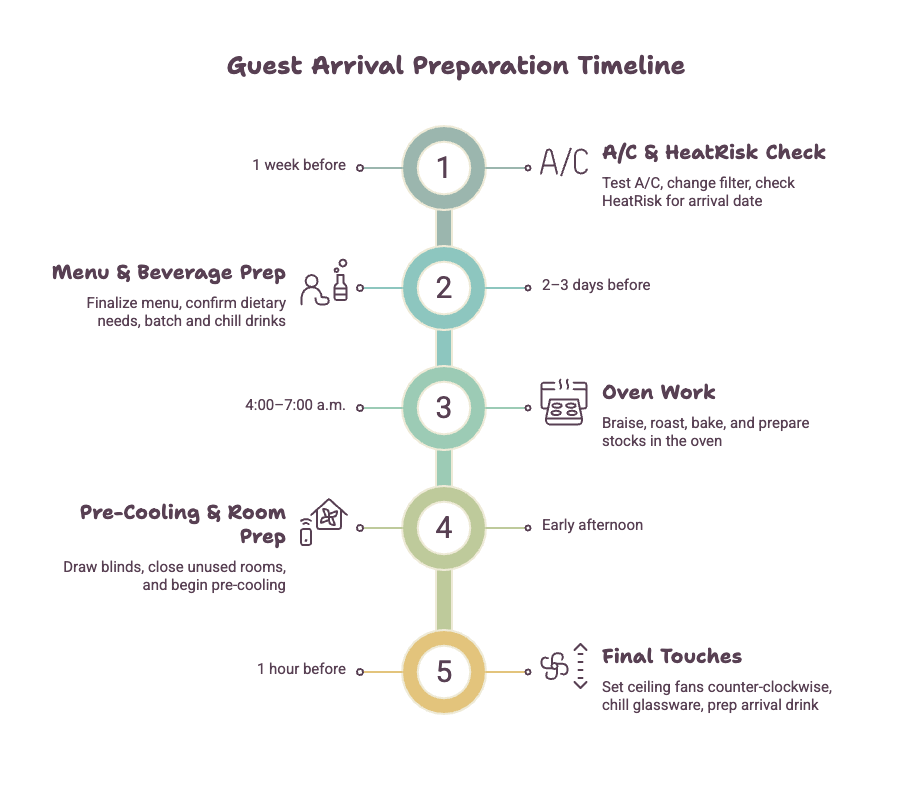
A forecast high tells you less than you might think. The National Weather Service doesn't rely on a fixed temperature for heat alerts here, because our bodies acclimate—105° in May feels very different from 105° in July. Their HeatRisk tool is far more useful: a simple daily color scale, available a week out, that factors in overnight lows and the duration of hot stretches. Check it as your date approaches, especially for out-of-state guests who haven't acclimated as you have.
Start later than you would in spring. The desert's temperature drops sharply after sunset, so an 8:00 p.m. seating in July creates an entirely different evening than one at 6:30 p.m. You'll catch golden hour through the windows—a meaningful detail in this landscape. Monsoon storms typically roll through in the late afternoon and then clear, offering another reason to lean later.
Evening isn't the only option, either. Some of the most comfortable summer gatherings in the Valley happen well before noon. A brunch or a breakfast at nine or ten in the morning sidesteps the heat entirely, and it's a genuinely underused format here.
One final timing note matters more here than almost anywhere: your guests will walk in from cars that have been sitting in 110° heat. Whatever happens in the first ninety seconds sets the tone for the entire night. A chilled towel at the door. A genuinely cold drink placed in hand before anyone has to ask. In this climate, that isn't mere flourish—it's the highest-leverage moment of hospitality you have.
Preparing the House
The comfort of the entire evening rests on one system. Most hosts check it only a few hours before guests arrive. Check it a week out instead. Run the air conditioning hard for an afternoon to see if it holds under sustained load. Change the filter. Walk through the rooms you'll use and ensure supply vents aren't blocked—a beautiful console table over a floor register is a common, invisible culprit.
Then begin cooling hours early, not minutes early.
This is where many hosts go wrong. Your system can move air quickly, but it can't quickly cool the solid mass in the room: stone counters, tile floors, a heavy dining table, west-facing glass that has absorbed sun since early afternoon. These surfaces hold heat and radiate it back for hours. A house that reaches a comfortable air temperature thirty minutes before guests arrive can still feel warm because the surfaces haven't caught up.
Draw the blinds on the west side early in the afternoon. Close doors to unused rooms. Give the whole house a genuine head start.
Also account for the guests themselves. Twelve people generate real heat. A room that feels perfect at five o'clock when empty will feel different at half past eight when full. Build in margin.
Two small but effective touches: Set ceiling fans to rotate counter-clockwise to push cooled air downward. And be thoughtful with candles—atmosphere matters at a summer table, but forty open flames add unnecessary heat. Cluster real flames where they'll be noticed and supplement the rest.
Cooking Without Heating the House
Every entertaining guide advises cooking ahead. That's correct, but incomplete for anyone cooking in the Sonoran Desert.
The desert version adds a second critical variable: what time of day.
Early morning—roughly four to seven—is the coolest window in a Phoenix summer. Anything that requires long oven time belongs then: braises, roasts, stocks, baked dishes. Do it early, and the house has all day to recover. Do it at four in the afternoon, and you're forcing your air conditioning to battle your oven at the peak of outside heat.
From there, a handful of kitchen habits make the biggest difference:
- Design the evening for zero oven time after late afternoon. Make that decision weeks ahead, not on the day.
- Reach for induction and countertop equipment. Induction directs energy into the pan, not the kitchen air.
- Spread the load. Running the oven, dishwasher, and four burners simultaneously creates a heat event. The same work distributed across the day is barely noticeable.
- Turn the hood on before you need it. Extraction works far better as prevention.
- Cook with lids on and use residual heat. Covered pots lose far less to the room. Proteins that finish while resting and sauces held off the burner keep the stove off longer than most cooks realize.
None of this is dramatic. It's the steady accumulation of small decisions that keeps the kitchen contained instead of quietly warming the room where your guests are seated.
Building a Menu That Works With the Desert
Structure Before Recipes
Cold, room-temperature, and gently warm courses aren't a summer compromise. In this climate, they're the format the season rewards—and they're where some of the most compelling cooking of the year happens.
It's worth remembering that heavy, high-protein dishes generate metabolic heat. Your body works harder to digest them, and you feel it more in a warm room. That creates tension, especially as protein remains one of the biggest trends in American dining.
The solution isn't avoidance, but thoughtful preparation: chilled and cured applications, lighter treatments instead of heavy braises, and smaller portions across more courses rather than one substantial plate. A crudo, a cool poached protein, a composed dish that satisfies without weighing heavily. This judgment separates a menu that reads well from one that truly performs on a 108° evening. Our sit-down plated menu is built around exactly this kind of coursing.

Flavors That Read as Cooling
Acid is the bridge—and it aligns perfectly with where flavors are heading. The National Restaurant Association's 2026 forecast highlights chili-lime as a leading flavor, with black lime and smoked citrus emerging close behind. All three brighten dishes and cut through richness in a way that feels physically refreshing when it's hot.
The same report notes growing demand for "flavor escapism"—food that transports you somewhere else. Caribbean curry bowls, miso-glazed proteins, za'atar flatbreads. In a Scottsdale July, these do double duty: they're on-trend and emotionally right for the room. Bright, citrus-forward Mexican cooking works particularly well in this climate, and a vegetarian menu built on peak summer produce is lighter on the room than most people expect.
Cooking With the Sonoran Summer
Arizona summer produce is far from barren—it's abundant. Local growers hit their peak precisely when the heat arrives. Tomatoes reach peak flavor. Melons last through September. Chiles come on strong in July. Summer squash and blossoms, heat-tolerant Armenian cucumbers, okra, and sweet corn all thrive while much of the country assumes nothing grows here.
Then there are ingredients found nowhere else. Saguaro fruit ripens in July, at the height of the monsoon—a harvest that has been central to Indigenous foodways in the Sonoran Desert for centuries. Prickly pear follows in August. These are true Sonoran ingredients, tied to the monsoon, and they rarely appear on dinner party tables. Used thoughtfully, they offer guests something genuinely unique in the country.
Dates also deserve mention. They're an emerging national dessert trend, and they're grown right here—local sourcing that's also ahead of the curve, and a natural fit for a dessert course that reflects where you actually live.
The Beverage Program Does More Work Than You'd Expect
Curated water service—still and sparkling, proper chilled glassware, electrolyte options—is having a real moment on American menus, with some restaurants even employing water sommeliers. In most of the country, that's a wellness flourish. In Phoenix in July, it's simply the most practical hospitality you can offer.
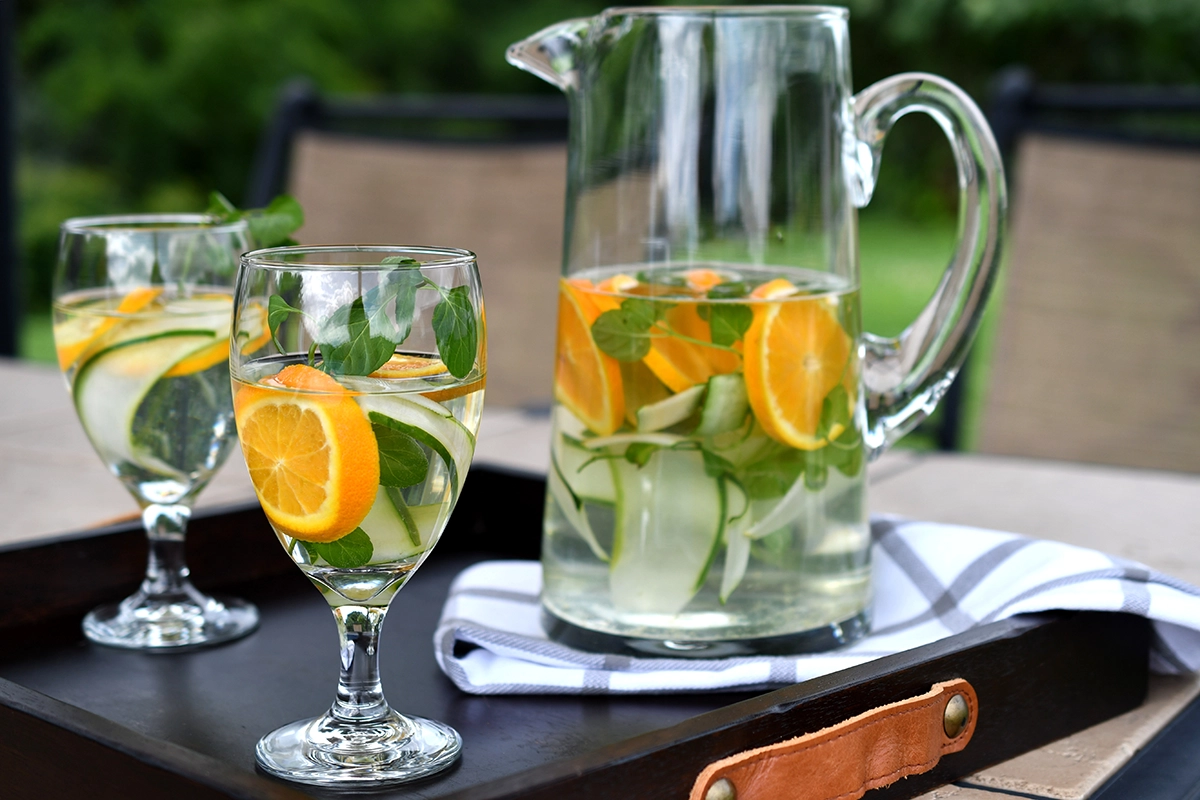
Your guests arrive dehydrated, whether they realize it or not. A thoughtful water program is straightforward and deeply appreciated: both still and sparkling, properly cold, with cucumber-mint or citrus-herb infusions in vessels worthy of the table. Above all, no one should ever have to ask for water or wait for it. In this climate, that's the detail people remember.
The zero-proof selection deserves equal attention. Roughly half of drinkers now say alcohol appeals to them less than before, and non-alcoholic beer and spirits have become an expectation. Someone driving home across the Valley on a 105° evening deserves better than a soda. Give the zero-proof list real complexity, proper glassware, and thoughtful garnishes. Tea makes an excellent sophisticated base. For larger gatherings, professional bar service takes the whole program off your hands.
Practical note: Batch and pre-chill everything you can. A drink that requires nothing from you during service is one that lets you stay at the table—and that matters more than the ingredients themselves.
Choosing How to Serve
Roughly half of hosts default to a buffet, yet that's the format that asks the most of you in a hot climate, because food sits out over time.
We've covered food safety and holding temperatures in Arizona heat elsewhere, so we won't repeat it here. The key point: the safe window for perishable food without temperature control is real and tightens as the room warms.
Plated coursing offers the cleanest solution. Courses arrive when intended instead of sitting for hours, and it naturally elevates the evening.
If you prefer the generosity of a spread, use smaller vessels replenished often—portions sized for twenty minutes rather than platters for the whole night. A properly staffed buffet with correct holding equipment solves the temperature problem that a self-serve table creates.
Staged service releases the evening in waves instead of all at once, solving one of hosting's biggest challenges: getting everything ready simultaneously.
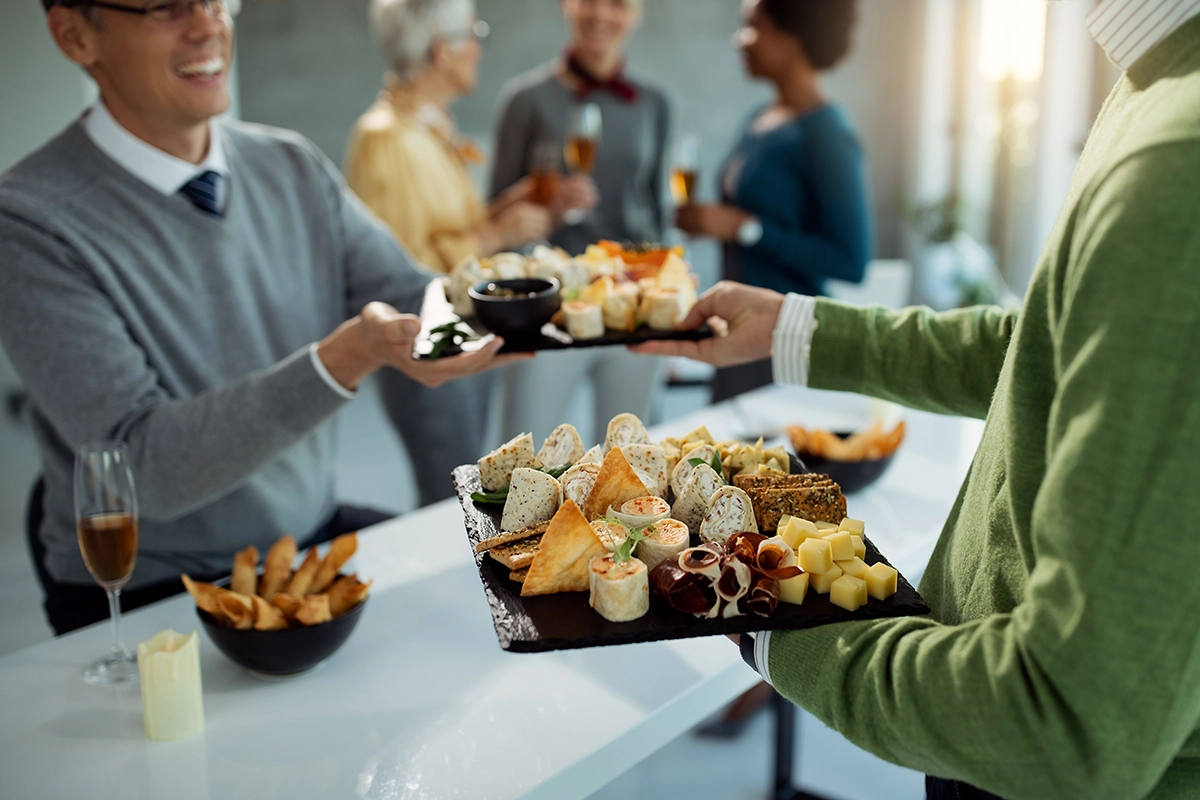
Passed hors d'oeuvres are rarely done at home, which makes them a genuine differentiator. They keep guests circulating and talking rather than queuing, and food never sits.
Designing the Flow of the Evening
American entertaining has loosened. Formality is optional, and evenings now unfold across the whole home rather than staying confined to the dining room—cocktails in one space, dinner in another, dessert somewhere else.
That's a national trend. In Scottsdale, it's also thermally smart. Desert homes cool unevenly, and the kitchen is invariably the warmest room. Moving the evening across two or three spaces spreads body heat, keeps guests away from the kitchen, and gives the night natural momentum.
A structure that works well: arrival and cocktails in the coolest room, dinner in the space furthest from the kitchen, and dessert or coffee somewhere different once the sun has fully set. Each transition resets the energy. This works especially well for a small gathering of eight to twelve, where the whole group moves together.
For atmosphere, lighting does most of the work—lamps and low, warm sources at eye level rather than bright overhead lights. On the table, the current direction is garden-inspired and hyper-local: seasonal stems in mismatched vessels instead of formal arrangements. In Scottsdale, that's an invitation to use what actually grows here—desert botanicals, citrus, monsoon greenery. It says more about where you are than imported florals ever could, and it ties the table to the plate.
One final note: about 44% of hosts in that same survey rely mostly on disposable plates and cups, while only 13% use specialty sets. The distance between those numbers is where true luxury lives—and it isn't primarily about expense. Real glassware and cloth napkins cost far less than most assume. They simply require attention.
The One Thing You Can't Prepare in Advance
Look at what a well-executed Scottsdale summer dinner party truly requires: a menu planned weeks ahead around courses that need no oven, heat-generating work done at five in the morning, a house pre-cooled for hours with blinds drawn and unused rooms closed, batched and chilled drinks, service staged in waves, and multiple rooms prepared instead of one.
Every item on that list is achievable on your own. A capable, motivated host can do all of it.
But add up the real cost. The host who executes everything perfectly starts cooking before sunrise on the day of the party, spends the evening managing the timing of five courses, and ends the night with a kitchen that still needs an hour of work. They've solved the heat—but not the original problem: being occupied instead of present.
To be direct: most people handle this themselves most of the time, and they do it well. The case for summer in Scottsdale is more specific. The conditions that make hosting manageable for ten months of the year are precisely what a Valley July removes—no patio to escape to, no grill to move heat outside, no margin in the timeline because every hot element must land at once in a room you're working to keep cool.
What changes when someone else manages that timeline isn't really about the food. It's that you're fully in the room. You greet guests at the door instead of calling from the kitchen. You hear the story as it's told rather than catching the end while plating. You sit for the entire meal, not just the middle of it.
In Scottsdale, in July, the true measure of a dinner party isn't what came out of the kitchen. It's whether you were there when it did.
Frequently Asked Questions
How far in advance should I book a chef for a summer dinner party in Scottsdale?
Two to three weeks works for most in-home dinners — enough time to build a menu around what's actually at its peak and settle on a date. For rehearsal dinners and larger celebrations, allow four to six weeks. Summer is the easier season to book on short notice, though. The Valley's calendar crunch runs January through April, not July.
How many guests can a home dinner party realistically hold in summer?
Fewer than in November, and the limit is usually cooling rather than seating. Every person adds heat, so a room that handles fourteen comfortably in spring can feel close with the same fourteen in July. If you're near your usual maximum, either spread the evening across two rooms or trim the list by a few. A smaller dinner that stays comfortable beats a full table that doesn't. For larger groups, full-service event catering gives you more options than a home kitchen alone.
What if my kitchen is small or dated?
It matters far less than people expect. A chef needs counter space, a working stove, and a sink — not a showpiece kitchen. Galley layouts, older appliances, and condos all work fine. Just mention anything unusual ahead of time: a single oven, no dishwasher, limited fridge space, or induction instead of gas. Those shape the menu, and it's better to plan around them than discover them on the night.
What should I do about guests with dietary restrictions?
Collect them with the invitation, not the week of. Ask about allergies specifically and note severity — an intolerance and an anaphylactic allergy require very different handling in a shared kitchen. Vegetarian and vegan, gluten-free, and pescatarian menus are all easy to build around when they're known early. What's hard is a last-minute plus-one with a shellfish allergy on a menu built around crudo.
Is it better to hire a chef or order catering for an at-home dinner?
They solve different problems. Catering delivers food prepared elsewhere, which suits larger gatherings and buffets where volume matters more than timing. A chef cooks in your kitchen and serves through the evening, which suits seated dinners where courses need to land at the right moment. In a Scottsdale summer, timing usually decides it — food that travels and holds well is a real constraint at 108°, and cooking on-site sidesteps it.
Planning a Summer Dinner Party in Scottsdale?
Tableside Gourmet's In-Home Dining Experience brings a professional chef into your kitchen. We craft a menu tailored to your evening, your guests, and the season—cooked and served in your home while you remain exactly where you should be: present with your guests.
We work throughout Scottsdale and the surrounding Valley, from intimate dinners for six to larger celebrations.
Explore our In-Home Dining Experience →